
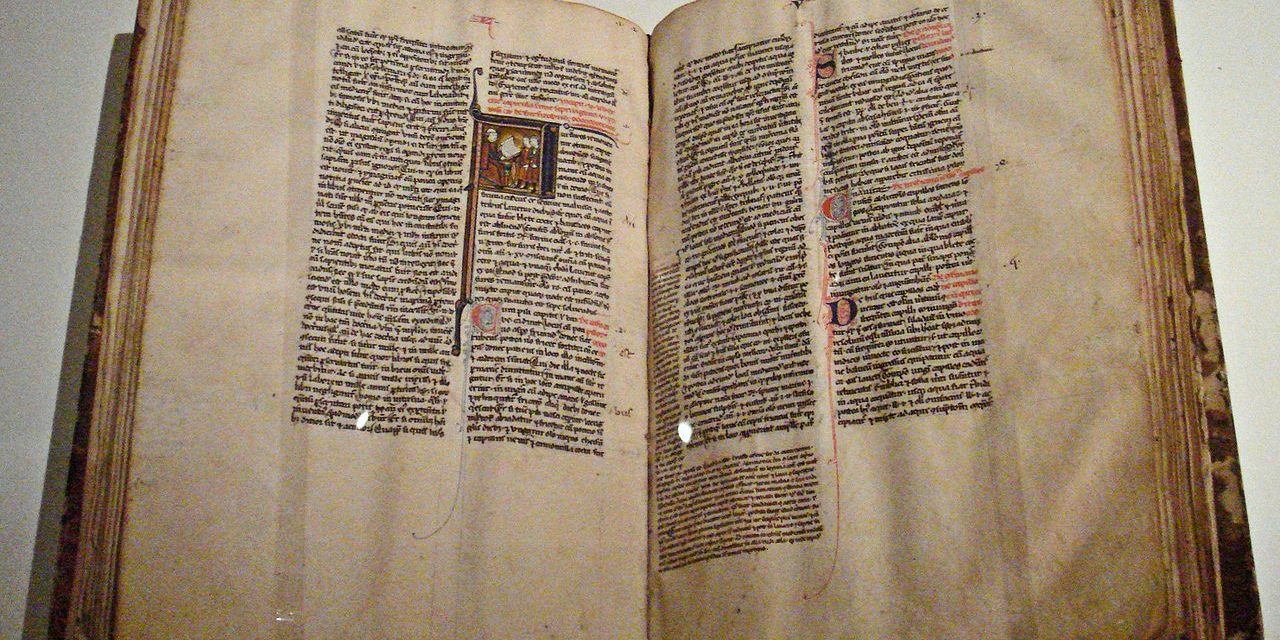

Resources on Medieval Literacy, Part 1
When we talk about Historical European Martial Arts we obviously tend to focus on the martial first and foremost. Most HEMA research emphasizes the content of the manuals themselves, parsing and reparsing the author’s words and comparing them line by line to other fencing manuals, crafting competing interpretations to test out in the gym and on the tournament floor. This has proven very useful for figuring out specific techniques and has helped elevate the current HEMA revival to the level it has reached today. But the approach also has built-in limitations, and when applied to trying to understand some of the most persistent ‘meta’ questions about the fight books it hasn’t held up as well. What little context research has been done in English so far tends to focus only on the personalities involved: who were the patrons of various fencing masters, which masters had membership in fencing guilds and so on. To a lesser extent the remainder has looked at the fighting that took place where and when the manuals were written: dueling and judicial combat, warfare and so forth.
Most of the debates which continue to rage across the interwebs today rely exclusively on the canonical interpretations of the ‘sacred’ text of the fight-books themselves, orphaned from the world they came from in a mysterious vacuum. Most HEMA researchers (let alone ordinary practitioners) remain content with an extremely vague sense of the martial context of the masters, fight-book authors, and fencing guilds, largely derived from the pop culture or genre literature. A whole slew of questions remain unanswered by these specific approaches. We wonder for example why manuals tended to be clustered in certain areas, why they focused on certain types of fighting and not others, and why we have found so few manuals produced before the turn of the 15th Century, and so many afterword. We have speculated about how fencing or warfare changed from the early to late medieval period, maybe we should be looking at the question another way.
One of the more obvious angles we have generally failed to adequately consider is the role of literacy in the period of the fencing manuals. If we are trying to understand the role of fencing books and other forms of martial arts literature, we should probably understand not only who fought, but also who could read. The cross section of the fighters and the readers, you might say. Illiterate people arguably have less need of books of any kind, less demand for them, than literate people do. And to some extent we can see that most of the fencing manuals, especially the early ones, seem to be written for an audience who already has a basic understanding of fencing.
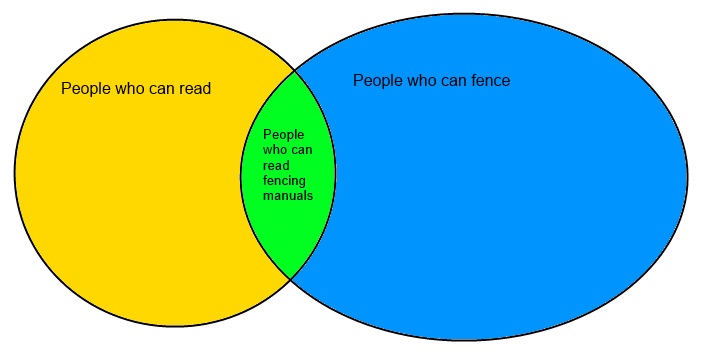
I know – this diagram is a little bit obnoxious. But it does help drive home the point.
Of course, if we go by the default pop culture assumptions about the medieval period, we would assume that very few people were literate and that those few who could read were members of the most elite social classes: kings, courtiers, and senior members of the Church. This rather simple story in turn strongly influences our understanding of who books were made for and who they were written by, and gives us a neat and clean narrative. But it doesn’t fit the manuals themselves and like most common assumptions about this period, it’s probably all wrong.
Zeroing in on the readers and the writers
Whether or not I can convince others of the importance of understanding the history of literacy in this period, it has been an interest of mine for the past six years. I have found some useful resources, and began to form tentative theories of what the “literate world” meant in at least some parts of medieval Europe. But there are gaps in my knowledge and I don’t yet have a complete picture, it would be foolish of me to attempt to fully create one. After all, as a friend recently reminded me, the past is a foreign country where one must tread carefully lest you offend the locals. The best we can do is paint a partial and very rough sketch. Even this though has a lot of value, and can be somewhat eye opening if you aren’t already familiar with just how different this period is from our general preconceptions.
We are lucky here in that literacy is an issue that has seen some serious scrutiny from Academia in the last few decades. Perhaps more importantly, there is an abundance of archeological and literary evidence and other clues which the academics have drawn from (and which we too can examine in our own special way if we choose to), which can help us understand a little bit about reading and writing and the production of books back in the time of the fencing masters. I’m going to share some of what I’ve found over the years here in the hope of encouraging other researchers to consider this angle in their own HEMA studies, and I selfishly hope, thereby contribute further to mine.
So without further digression, I’ll go right into a rough timeline I’ve put together, describing the development of literacy in the medieval period. To start with, we have to define the term and it’s starting point. People use different definitions of what they call medieval, but we can say that toward the end of the first millennium, the end of what we sometimes call the Migration Era or the Völkerwanderung,coincident with a general period of economic and military expansion in Europe, literacy went from something which was the province of elite theologians to an increasingly necessary tool of commerce. Before that happened though there was an intellectual flowering, and the immediate source of that came from beyond Christian Europe.
Precursor to Europe: The Muslim scholars
Medieval European intellectual life had its most direct precursors in the Islamic Golden Age. From the 8th – 12th Centuries, the Islamic world from Persia, to Syria, to the Moorish kingdoms of Al Andalus in what is now Spain, experienced an explosion of intellectual growth largely stimulated by the translation of texts from the ancient Greeks, whose work was further expanded upon and brilliantly developed by a series of scholars who can only be called geniuses. Major advances in the fields of chemistry, math, astronomy, biology, and medicine were established in this era which would remain influential in European schools and Universities for the next six or seven centuries.
Regardless of how you may feel about Islam in today, you really cannot understand the intellectual world of Medieval Europe without having at least a basic grasp of some of the great works of authors such as Al Razi (astronomy, chemistry), Avicenna (medicine), Al Kindi (astronomy, optics, cryptography), Al Jabir (mathematics, chemistry), and Al-Jayyānī (trigonometry) just to name a few. These men and others set the bar for translating and interpreting the Greek auctores, (roughly, “authorities”) who were of such importance in the early medieval period, such as Aristotle, Euclid, Hyppocrates, Ptolemy and Epicurus. The names of these Muslim scholars were as well known to Latin-Christian men of letters in the medieval period as the Classical auctores themselves were.

A late 15th Century German copy of the Tacuinum Sanitatis, a manual of health and wellbeing, which was a translation of the
11th Century Taqwim al‑sihha by the Arab scholar Ibn Butlan of Baghdad.
The last and most directly influential outpost of this Islamic flowering was the fantastic library of Cordoba in Al Andalus, which some people estimate had over 100,000 books. The importance of the library of Cordoba was noted by such important European scholars as the famous Saxon nun Hrotsvitha of Gandersheim, who is believed to be the first person to write plays in Latin since Classical times. She called Cordoba ‘the ornament of the world’ due to the fantastic collection of Latin manuscripts there. The near total destruction of the library in the 11th Century at the behest of Muslim religious fanatics is arguably on par with the burning of the Library of Alexandria.
But in spite of this and many other disasters and outrages, correspondence between scholars in the Christian and Muslim worlds remained active and very important throughout the medieval period. For example the English Franciscan monk Roger Bacon of Oxford is believed to have learned the formula for gunpowder from friends, you might say pen pals, he was corresponding with in Moorish Spain, including Jewish and Muslim scholars. It would be difficult to overstate the importance of his publication of the formula for gunpowder in his Opus Majus in 1267, a little more than twenty years after the Mongols first introduced it on the battlefields of Eastern Europe.

A depiction of picking garlic from another copy of the Tacuinum Sanitatis, from Lombardy in the 14th Century. This very popular and influential book was published at least six times by scriptoria in Italy and an unknown number of times in Germany and the Rhineland between 1300 and 1500. Four copies survive today
The longest lasting legacy of the impact of the Muslim scholars was the continued use of their names as noms-de plume by European scholars in the late medieval period. For example one of the most famous books on chemistry was written by an unknown but very gifted 13th Century Spanish chemist we know only today as ‘pseudo Geber’, as he was pretending to be the more famous Persian scholar and alchemist ‘Geber’ or Al Jabir, aka Jābir ibn Hayyān “The pharmacist”.
Medieval scholars did not have the kind of prohibition against plagiarism that we have today, for example when the 15th Century German scholar Regiomontanus (Johannes Müller von Königsberg) discovered the works of Al-Jayyānī, (which were largely derived from Euclid and Ptolemy) he did little more than make a comment that he’d discovered a book with ‘marvelous secrets about triangles and circles’ which he published as his own treatise on trigonometry. This very book, incidentally, was used by Christopher Columbus to predict an eclipse to awe natives during a famous incident in the Caribbean (underscoring the point so well understood by the medieval scholars: these ancient books had real power). But the habit went both ways, and European scholars often shyly or slyly, out of convenience, playfully or with sinister purpose pretended to be scholars from the Muslim world.
It’s important to note that the Classical auctores were not only rediscovered via the Muslims. Irish monks, the Vaticans own libraries, and perhaps most importantly, the Byzantines preserved many priceless works of antiquity. Once their value became properly understood, starting in the 11th and 12th Century, Latin scholars also began to visit and search through abbeys, convents and monasteries throughout Europe, seeking the wisdom of the ancients. This correlated with rapid economic and social changes throughout Europe going on at this time, (but more about that in a moment). For some reason however, it seemed to be the Muslim scholars who really captured the imagination of the Latin scholars.

A 13th Century Latin copy of one of Al Razi’s 40 + books on medicine,originally translated from Persian by Gerard of Cremona in 1175
The 11th Century: A center of translation, and the world’s first university
The disappearance of Cordoba’s fantastic library was not the end of intellectual seething that had started in Europe, it simply shifted from the Muslim zone to the Christian zone. The fervor for the work of the ancients spread throughout monasteries and towns of northern Italy in the 11th Century, and the translations were increasingly being done in certain centers of activity in Spain, in Italy, and eventually in Flanders, and throughout the large abbeys and the more urbanized parts of Europe. Special centers of translation, such as the fantastic ‘school’ in Toledo began to coalesce. In other towns the art of interpretation became refined, and clusters of scholars began to specialize in medicine, or law, or theology, or astronomy.
The translating school in Toledo bears a second look. Originally organized by Raymond of Toledo, a far-sighted Archbishop with an obsession for Aristotle, the school took advantage of the proximity of many native Arabic and Hebrew speakers to begin translating the works of the Muslim masters. Early translators such as Gerard of Cremona, John of Seville, the Scotsman Michael Scot, and the Flemish Astronomer Rudolf of Bruges achieved wide fame due to their translations of important scientific manuscripts from Arabic into Latin. (This school continued to be important into the next century and we will return to it a bit later…)
As most HEMA researchers might very well assume, the next logical step from a translating school was to formally organize the process of interpreting and further developing the ideas of the ancient Greeks and the early medieval Persians and Arabs. In 1070, scholars in Italy located a compendium of Roman law from the era of Emperor Justinian I, which came to be called “The digest“. This was kind of the mother lode of late Roman law, and because of the advantage it conferred in lawsuits, students from all over Europe began to flock to the area to learn it’s secrets. In 1088 AD the natios of these students came together in the little town of Bologna and made international history by founding the world’s first true University. These days the University of Bologna is eclipsed by the fame of the world’s second University in Paris, but Bologna was arguably the more important of the two, because whereas Paris was a school of theology, Bologna was a secular school, initially a school of civil (Roman) law. This was a big deal in the intellectual landscape of Europe, as it opened the door to serious study of non-theological subjects, and made it acceptable to study the Classical auctores without debating how many angels could dance on the head of a pin.
Universities soon spread throughout Italy and beyond, (Oxford, in England, was the third) with at least 11 more founded before the end of the 13th Century, but Bologna retained a special position. This both due to the type of study that was done there (primarily law but many other subjects as well) and also to the way the school was organized, with students electing their professors and rectors (judges). To assert that Bologna remained the most important university in Italy one must only note that Dante, Boccacio and Petrarch were just a few of the schools more distinguished alumni.
It is important to note that the fervor for study was not entirely high minded, medieval scholars were deriving very pragmatic information from Greek classical masterpieces and the Muslim scholars. Chemistry to enable the separation of gold, silver, and copper from their ores, and to fix dyes; the secrets of geometry and architecture to build Cathedrals, castles, city walls and siege engines; medicine for obvious reasons, law to gain an edge in contracts and lawsuits, all had very immediate real world value. Even the study of theology contributed to the very practical world of Church politics and canon law. But perhaps most important were the advances in engineering.
Alongside the intellectual revolution of the 11th Century, there was another equally important one. We get a clue of what was coming in the domesday book of England in 1086, essentially the census by the Normans of their newly conquered land. The book lists more than 5,600 water mills in England at this time. Fifty six hundred. Within the lifetime of William the Conqueror, the labor of grinding grain had been all but eliminated even in one of the least urbanized regions of Europe. The dawning of an age of machines was at hand. Europe was already well into a dramatic transformation into the most mechanized society the world had ever seen.
The 12th Century: Mechanization, an economic revolution, the first paper mills
The 12th Century saw the rapid rise of thriving towns grouped together in several distinct regions of Europe. The most famous of these nascent urbanized zones are Northern Italy and Flanders. A little study reveals that the Rhineland and Catalonia were also important, as was Languedoc in France, and further north and East, Silesia in what is now Poland, Bohemia (now Czech), and lower Saxony all experienced the rapid growth of their urban centers. Though the money from merchant culture was driving much of the activity, during the early part of this era it was the spread of the overshot water wheel across the length and breadth of Europe, largely the work of Cistercian monks, which transformed European trading and religious centers with the rapid development of water powered machinery.

A 12th Century watermill from Flanders in what is now Belgium
Water mills had been known in Roman times, and were improved somewhat by the Arabs, but were transformed by the Europeans. Devices of ½ horsepower had been increased by a factor of 12 to 6 horsepower, and a whole series of inventions such as the crankshaft, crank slider and camshaft expanded their usefulness exponentially. Camshafts were known to Greeks but were used only for automata and other toys.
Using the geometry of Euclid and the ideas of the famous robot maker Al Jazari and others, European engineers developed these devices into a critical component of mechanizing a wide range of processes, from sawing wood to fulling cloth to operating bellows of forges and mechanizing trip hammers.

Interior of a 14th Century watermill, from England
By the 12th Century a small water mill could grind more grain than 40 slaves had been able to back in the days of the Roman Empire. Most towns had clusters of dozens of mills along their bridges and riverbanks, for example in the second half of the 12th Century the city of Toulouse had 60 floating mills operating in the river Garonne. In the 12th Century the use of mills for fulling, a critical step in fabric-making, spurred the growth of the textile industry and led to a dramatic acceleration in the spread of mills. Tidal mills were also developed in Europe at this time and spread widely, as did a new type of wind mill, the post mill, which turned when the wind changed direction, both devices spread mechanical power into the low lying coasts where the streams didn’t flow as fast.
To better understand what medieval mechanization was like, I highly recommend watching a few minutes of video, seeing them in action is more informative than anything you can read.
Water powered trip hammer in a village in Austria
A more typically medieval water mill grinding grain in England
A beautiful medieval sawmill in Norway
This labor saving revolution had cascading effects through society, initially in the agricultural, iron, ship building and textile industries, but soon to effect nearly all production in Europe one way or another. It was in Aragon (today Catalonia) where this proceeded the most rapidly, and it was here that the first true hydro-powered Paper mill in the world was built in 1144 AD[i]. The key technology of interest here is paper, a revolutionary writing material originally invented centuries earlier in China, but relatively new to Europe. Making paper with a water powered mill was a new thing under the sun and a serious game changer. It was at least as important a development in the history of literacy as the appearance of the first Universities.
The paper revolution
Writing materials were a problem in the early medieval era, because the source of papyrus, the original and best writing medium in antiquity, had been largely cut off by the Arab expansion of the 7th and 8th Centuries. As Henri Pirenne noted, the last Merovingian chancery document written on papyrus was in 692. This left Europeans stuck with using pieces of animal hide, the parchment and vellum which are so commonly associated with the medieval period in the popular imagination[ii]. Parchment (etc.) had some value, as it made for long lasting documents, but it was obviously expensive and labor intensive and not ideal for casual use by any means. And “casual use” was crucial to the spread of literacy.
The advent and spread of the water-powered paper-mill however introduced the production of paper on an industrial scale, which in turn made books much cheaper, made paper available to ordinary people, and returned reading and writing to the informal and prosaic world of commercial and private use. The new technology of the paper mill rapidly spread from what is today Spain to northern Italy where the towns were rising in economic and military power, and in intellectual ferment centered on the new Universities in Bologna, Modena and Padua. But paper was not just for local consumption, and it was in Italy where the paper mill quickly became the engine of a new major export industry. By 1268, the small town of Fabriano in Italy had 7 working paper mills. As with many other exports, much of this trade was “ultramontaine”, it went north across the Alps, where the Italians bought most of their woolen textile fabrics. The epicenter of the northern trade was an exotic and distant land called Flanders, where a new phenomenon began to emerge with the appearance of the Beguines.
(End of Part 1 – the Bibliography will be provided in the end of Part II)
[i] see J. N. H. LAWRANCE “The Spread of Lay Literacy in Late Medieval Castile”
[ii] It’s worth pointing out that birch bark was also used as a writing material, notably and most famously in some of the Russian cities like Novgorod, Pskov and Tver.







Looking forward to part II!
Thank you for this interesting read, Jean C! I really enjoyed it and am looking forward to the coming part(s).
That said, I think you under-represent the role learning had in medieval Europe from the Karolingian times onward to the foundation of the first Universities aside the translation movements. In fact a lot of knowledge was retained by the church and teached in cathedral and monastic schools. These schools drew directly on the late roman tradition of education and 789, Charlemagne’s Admonitio Generalis required that schools be established in every monastery and bishopric, in which “children can learn to read; that psalms, notation, chant, computation, and grammar be taught.” The seven artes liberales were already at the foundation of this education.
And while these schools always looked after religious education aside those liberal arts it is quite unfair to say that only with Bologna there “opened the door to serious study of non-theological subjects, and made it acceptable to study the Classical auctores without debating how many angels could dance on the head of a pin”, as exactly such questions like how many angels can dance on the head of a pin arose with the Scholasticism of the Universities. Bologna was part of that development, even though mainly a law school, because the Trivium (grammar, rhetoric and dialect) was at the foundation of law at the medieval university and was the area from which such purely speculative questions arose.
So, non-theological subjects were studied in Europe before the rise of Universities. Bologna certainly didn’t need to open this door. Rather Bologna could rise because that door was already open. Also, Bologna wasn’t a ‘secular’ (in the sense of being apart from the church) school either, even though it was founded in large part due to the rediscovery of ‘the digest’ there was canon law (in itself a primarily secular ‘activity’ of the church, of course) studied in Bolonga and well established by 1140 when Gratian teached and researched side by side with the Four Doctores of Bologna.
Tl;dr: Aside that use of “How many angels can dance on the head of a pin?” as a metaphor for wasting time debating topics of no practical value, or questions whose answers hold no intellectual consequence, which seems to be an anti-church/religion snipe and the oversight of the continued tradition of roman education through the Karolingian times up to the development of the liberal schools and universtities out of the cathedral and monastic schools, I think this is really a good read. And I have in fact much more praise for the remaining parts than the few lines I spared for them here might suggest.
Regards
Peter Lührs
Hi, Peter,
I heartily agree with the points you make on the literacy issues, I come from the legal side where the are piles of records from the “Dark Ages” and High Middle Ages, usually mind-numbingly boring documents dealing with land transactions and wills – but evidence of a fairly robust tradition of literacy nonetheless. Makes non-sense of a textbook for university-level German literature I bought which said that until the late middle ages, only monasteries produced writing, which is patently wrong but still a notion that we continuously fight against.
Regarding angels, I’ve gotten into that a bit – it seems the concept of “angel” was short-hand for “here is a mechanism we don’t yet understand”. And the speculation on how many angels dance on the head of a pin is not empty airy-fairey, but grappling with Zeno’s paradoxes: The fact that an infinity of nearly-nothing will yield a hard, precise number. Becoming willing to accept that fact laid the intellectual basis for infinitesimal and integral calculus.
Jurg, good point about the angels, though I still find such discussions dubious (including what parts of the Summa Theologica I’ve actually read) but that is due to my unfair bias against philosophers in the modern sense. I do, I think, address this issue of literacy in the Merovingian and Carolingian period a bit more in part II. While clearly there were among the Clergy in particular, a class of literate people continuously going back to the decline of the Western Roman Empire, I think there is some evidence that literacy among people outside of the Church was not as widespread as it later became in the 12th and 13th Century, and also how and why this came about, but I don’t want to give too much away. I’m uploading Part II today so hopefully you will get to see it here in a week or two, depending on when Roger decides to release it.
Peter,
Thank you for your thoughtful and well written reply. You raise fair points about the tradition of public education under Carolingian (and even Merovingian) rule in the earlier medieval period, and in a sense, you are correct that it was an unfair dig at the Church to make the remark about angels dancing on the head of a pin. I can only excuse myself by saying that in the name of brevity for my already very long article, I had to resort to some shorthand in order to get certain basic points across. I did summarize in the very beginning that prior to the end of the 1st Millennia, literacy (and numeracy) had spread from the Church to the common people to some extent for commercial reasons.
With regard to the differences between the Universities of Bologna and Paris, yes it is true that there was a considerable degree of overlap (and indeed, it was the nature of University study in the medieval period that students moved from school to school and many attended both Paris and Bologna during the course of their study) it is also true that there was a major and very important difference between the two. The fact that Bologna was first and foremost a school of civil law as opposed to theology is significant, but so is the manner in which the Bolognese school was organized as opposed to Paris, the former being based on the organizations of the students themselves and the latter far more hierarchical. The significance of this to the Scholastic movement was shown in the 13th century (which we will see in part II) when the Bishop of Paris cracked down on the study of Aristotle specifically and the ‘pagan’ excesses of the Scholastics in general, in 1210 and 1277, of which I’m sure you are aware. For any others who may be following along:
http://en.wikipedia.org/wiki/Condemnations_of_1210%E2%80%931277
The two competing models of University, the Bolognese and the French, continued to be (I think) the most important and significant difference between medieval Universities for the next several centuries. The fact that we only have today something more like the French model does not in any way diminish the importance of the other, older type during the medieval period, though it is also of course true that many, probably most of the students and professors of both schools were members of the Church in one form or another. The debates about how to approach (what we call today) science, and the study of Classical sources and education in general, the trivium and the quadrivium and so on, was very much a debate within the Church as much as it was between the Church and other institutions. The Church was by no means a monolith, as I’m sure you are aware we even had some Humanist Popes, such as Pious II who I’ll be featuring in part II or III. I did point out the crucial role of Bishop Raymond of Toledo in establishing and protecting the vital translation school there.
This latter area is where I will also focus in part II on the development of the schools. As you noted the monastic schools existed back to Carolingian times, but in the 13th Century the prominence of the Dominican order in running these schools increased, which corresponded to increasing resistance to Church influence particularly in the towns where most of the economic and intellectual activity was taking place. It was at this time that the towns began to establish their own schools, not just within the town walls but also in the rural areas around them, and I believe this was really crucial to the further spread of literacy especially in the hinterland, in places like Flanders, Lombardy, and the Rhineland among others.
Thank you for your interest in my article and I hope the next part will pique your interest as well,
Jean
Jean,
Thank you for that detailed and insightful reply! And of course I understand that you had to take the length into consideration and couldn’t cover everything for the sake of brevity. Also, I think the comment about the “angels on a pin” coloured my perception of the rest of your discussion of the Bologna University and how it compared to Paris University.
I think your explications in this response allowed me to appreciate the point you were trying to make (as I understand it now) much better than before. I can of course appreciate that you point out that Bologna was less a target of the upper echelons of the church hierarchy ‘cracking down’ on the university staff in regard to what and how to teach, because of the differences in how the two universities were organized at the time. So in that sense it was certainly a ‘secular’ school opening up a new quality in teaching and learning.
I’m really looking forward to part II!
Peter
Hi Jean. Well done, I would like to add lots of small remarks, but 1. time is missing for me now 2. the overall concepts are nicely put and fit right in my own “desiderata” for further studies. There are lifeS of researchers ahead to fill in the blanks. As you pointed out, our “community” is very knowledgeable when it comes to analyse texts and images, but from a strict academic point of view, still too poor regarding closing the Fight books and start looking outside. Reading you makes me feel less alone preaching for medieval and renaissance studies. I hope lots of us would read your article. When is part II due?
Daniel, I’m very honored that you read my article and even more so for your kind words about it. Part II, by coincidence, was published today. I hope you like it and look forward to discussing it further. I hope I haven’t made too many big mistakes it was a lot of research!