Articles
The Secret Fechtbuch of the Little Fuggers Federschwert or a blunt longsword? Deutsche Fechtkunst im 16. Jahrhundert Spinning around Hollywood Style Is there really a Left Vom Tag? How do you do the Vom Tag? How long should a longsword be? How do you grip a sword? Training for war, according to von Wallhausen
Reviews
Reviews of Sparring Swords Scimitar Fencing Shoes Lutel 15019 Albion Regent
Articles.
How long should a longsword be?
Author: Roger Norling of Gothenburg Historical Fencing School
Published: 110126.
A simple reply would be long enough to reach your opponent. Stupid answer, I know... But the question is also stupid... sort of. Let me explain.
Real longswords from the Middle Ages and the Renaissance can range from about 110cm - 150cm with a medium probably about a 120-125cm, which is the "standard" length of most sparring swords today as well, give or take a couple of centimetres. However, when we look at illustrations in the fechtbuchen, we soon discover that the swords shown usually reaches from well into the armpit all the way up to the forehead. We may also consider the advise of Filippo Vadi, which although slightly ambiguous may be interpreted as further reinforcing this notion;
with the pommel just under the arm ,
as here is written.
To avoid any hindrance:
the pommel should be round to fit the closed hand
do this and you won't be in troubles.
And know for sure
that the handle should be a span long,
use other measures and you'll be confused."
Judging from this it would seem as if most modern sparring longsword are quite a bit too short.

Why then do we see so many seemingly longer longswords in the fechtbuchen and in Renaissance paintings?
Part of the explanation may be the simple fact that people were a little shorter back then. Not as much as the modern myth would have it, but a couple of inches, a little depending on the time period and social status.
Another reason may be that many swordsmiths base their designs on shorter war swords or swords intended for other civilian uses that required swifter response against sudden attacks or in crowded space; swords not specifically for judicial duelling or "school fencing". As such, they are simply not representative of what we study.
Another explanation could be that training swords were intentionally made longer in order to make the underlying fencing principles "clearer". Of course, many swords of war were also of a similar length, but there is a certain logic to this explanation
Finally, for some modern swordsmiths it may also be a question of economy and practicality, where longer swords require more work, more space and therefore also in part different tools. Some modern swordsmiths have perhaps adapted to a common standard that doesn't properly reflect the historical context we study.
It is hard to know for sure. The only thing we can be certain of is the fact that a large portion of the illustrations show longswords that are proportionally a good four or five inches longer.
So, does size really matter?
Well according to those with bigger swords, yes indeedy. It does. Several Eastern European HEMA clubs like Gesellschaft Lichtenawers and Fechtschule Gdansk have picked up on this and have begun working with considerably longer longswords with a length of about 135cm for a fencer that is 180cm tall. Also a few Swedish fencers have done the same. The impressions they have shared claim that the fencing techniques and principles become much clearer.
Just thinking theoretically about this change in proportions between man and weapon, this both changes the distance handling, the available time to react and also how the bind works. - A common problem with short and light swords is that it is almost as fast to strike around as it is to work from the bind, which makes the "Drei Wunder" more or less obsolete. With longer, and somewhat slower swords, it makes more sense to remain in the bind and work from there.
Based on the images shown above, and others not listed yet, I think that this warrants some consideration and exploration. Personally, I am waiting to receive a sword of this length, but I would appreciate any comments from other fencers and will happily add them to this article.
Addendum:
Feb 8 2011
- I noticed that the Wikipedia article on federschwert actually lists their average length at 132cm. I have no idea on what grounds this is based, but it is interesting. If this suggestion is valid, it might reinforce my theory on practice swords commonly being a bit longer than civilian and military sharps.
Furthermore this document describes a federschwert which has a blade of 95,8cm, a hilt of 17,8cm, a total length of 130,5cm and a weight of 1384gr. This is the federschwert which currently resides in the Landesmuseum in Z�rich. It is also the federschwert upon which Hanwei based theirs.

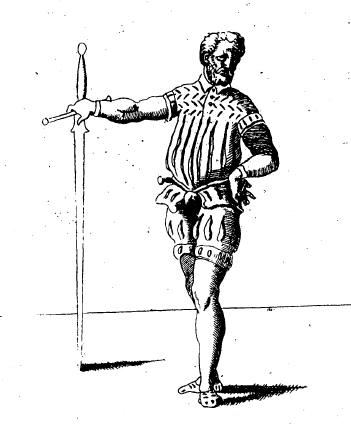
Here is another picture of a practice longsword taken from Camillo Agrippa's 1553 manuscript.
Another suggestion I have seen, is that the particular shape of the federschwert with a flared ricasso is a relative of the "extra" cross seen on many 16th and early 17th century bidenh�nder, and even suggestions that federschwert were made by grinding down used up sharp swords. I have seen little to support this notion, but, then I came across this image from GA Lovino from 1580 which adds some credibility to the thesis.
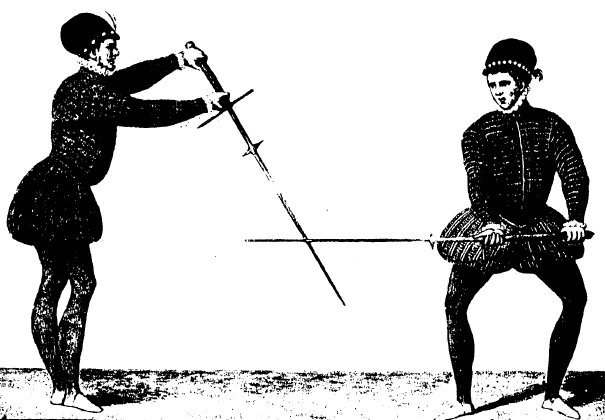 These Italian two-handed swords shown in Lovino are quite similar to this one, that currently resides in the collection of the the New York Met.
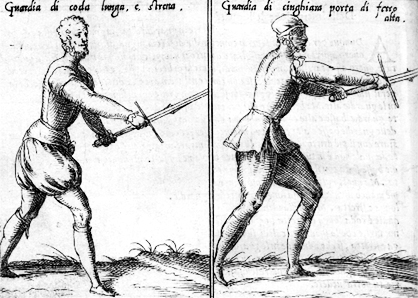
 Proper Spada da Due Mani with "extra crosses" can also be seen in Marozzos manuscripts from 1536 and 1568
 There may also be connections to the common practice of the various Renaissance guilds serving as city guards, making it useful to practice how to use long and powerful weapons like the bidenh�nder, the halberd and even the flail. In the words of Giacomo Di Grassi:
But because one may with it (as a galleon among many gallies) resist many Swordes, or other weapons: Therefore in the warres, it is used to be placed neere unto the Ensigne or Auncient, for the defence thereof, because, being of it selfe hable to contend with manie, it may better sauegard the same.
And it is accustomed to be carried in the Citie, aswell by night as by day, when it so chaunceth that a few are constrayned to withstand a great manie. And because his waight and bignes, requires great strength, therefore those onelie are allotted to the handling thereof, which are mightie and bigge to behould, great and stronge in bodie, of stoute and valiant courage.
Who (foreasmuch as they are to incounter manie, and to the end they may strike the more safelie, and amase them with the furie of the Sword) do altogether vse to deliuer great edge blowes, downe right and reversed, fetching a full circle, or compasse therein, staying them selues sometimes upon one foote, sometimes on the other, vtterlie neglecting to thrust, and perswading themselves that the thrust serueth to amaze one man onelie, but those edge blowes are of force to incounter many.
It should be noted that this is diGrassi's advise on fighting with the two-handed sword only when outnumbered. His advise on single combat is quite different, not least in the common use of single-hand thrusts.
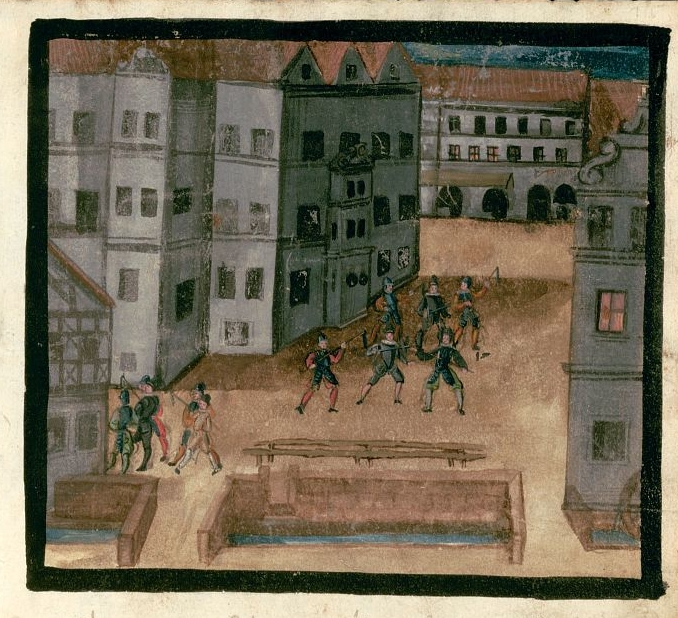
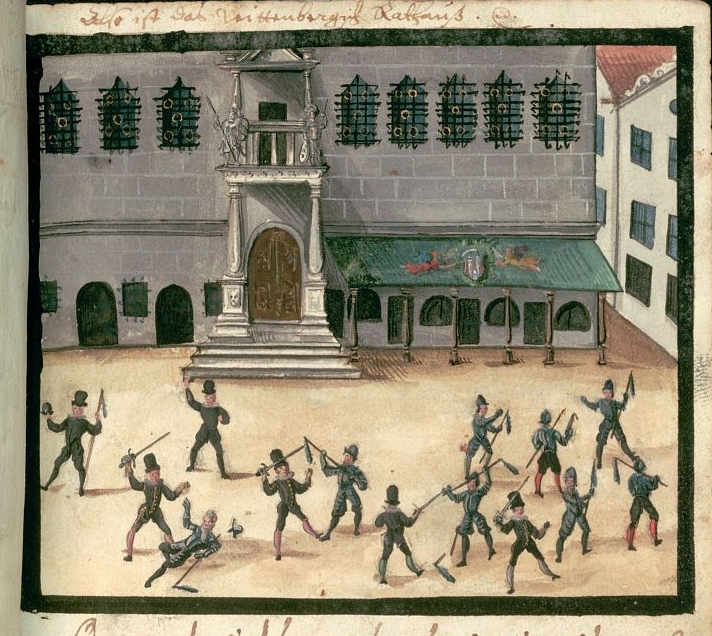
With this in mind, it would seem logical to at least in part practice with training swords that behave similarly to the large two-handed swords. Another clue to the connection between the fencing guilds and the city guards may be the elusive flail that is shown in illustrations of fechtschulen, but never really discussed properly in any fechtbuchen. Comparing to the Stammbuch of Simon Von Haendel, it seems as if the flail was used by the city guard, at least in certain cities of late 16th Germany.
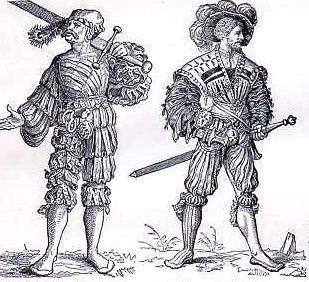
Finally, there are also indications that there were connections between the practice of the 16th and early 17th century fencing guilds and the infamous doppels�ldners of the Landsknechte, which of course are tightly associated with the use of the bidenh�nder.
Added on 110214:
In the image selection above I have tried to work with images that I have deemed to be more realistically drawn than other manuscripts, thus making them somewhat more reliable in the sense that they show above average consistency in portrayal of swords.
But to be "fair", I have also cross-referenced to manuscripts of a "lower" quality, ie less realism and less attention to detail.
Based on this, a notable exception to the above is the remarkable anonymous Codex.1.6.2.4, which bears much resemblance to several of Paulus Hector Mair's manuscripts. Here the "feder-longswords" vary in length reaching only to the waist, to up to the armpit. The same goes for Paulus Hector Mair's 1550 manuscript, Joachim Meyer's 1560 manuscript and the J�rg Wilhalm manuscript.
However, looking at ms.0963 from 1538, the Glasgow-fechtbuch E.1939.65.341 of 1508, the Christian Egonolph manuscript, Paulus Hector Mair's manuscript of 1542, Joachim Meyer's of 1560 and several more, further reinforces the argument that our sparring swords should be a bit longer than we generally use.
Added on 110414:
Here is another interesting detail from a larger image by Franz Isaac Brun dating to about the mid 1500s. It shows Landsknechten practicing with dussacken, pikes and "federschwert", just as in the manuscripts of Mair and Meyer. Particularly interesting is the length of the sword, which although being partly obscured can be assumed to be of substantial length, and the "nagel" of the dussack, something we usually associate with the messer. True, the men look like hobbits, which appears to be part of the illustrator's style, but the image is interesting nevertheless.
 Final conclusion
Although there is a certain variation in length of the longswords in the various sources I have looked at, there appears to be a dominance for longer longswords. Furthermore there is also a clear dominance for the so called "federschwert" in the Renaissance sources of the late 15th and the 16th century.
Supported by Gothenburg Historical Fencing School
A Perfect Length II: The Longsword This discussion on proper length of longswords might also interest you (Swedish only) A brief description of longswords by Gesellschaft Lichtenawers Anderthalbh�nder � Zweih�nder � Langes Schwert - zu Klassifikation, Nutzung und Bezeichnung der gro�en Schwerter des Sp�tmittelalters und der fr�hen Neuzeit - by Tilman Wanke