Articles
The Secret Fechtbuch of the Little Fuggers Federschwert or a blunt longsword? Deutsche Fechtkunst im 16. Jahrhundert Spinning around Hollywood Style Is there really a Left Vom Tag? How do you do the Vom Tag? How long should a longsword be? How do you grip a sword? Training for war, according to von Wallhausen
Reviews
Reviews of Sparring Swords Scimitar Fencing Shoes Lutel 15019 Albion Regent
Articles.
How do you do the Vom Tag?
Author: Roger Norling of Gothenburg Historical Fencing School
Published: Jan 26th 2011
No, it's not the hottest, new move on the dance floor. It's just the old High Guard as it is taught by Master Liechtenauer and his disciples, may God rest their souls. But how should it be done, really?
The guard Vom Tag is a simple thing when you look at it super- ficially. However, when you examine the often ambiguous advise given in the manuscripts and reflect on the possible translations of words and sentences, while comparing with the illustrations, you soon realize that the term Vom Tag contains a very broad spectra of possible stances.
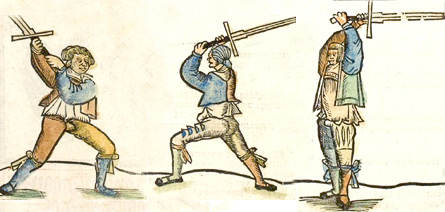 Basically there are two variants of the Vom Tag. Vom Tag and High Vom Tag. Vom Tag is most commonly held close to the shoulder and High Vom Tag is held with the sword above the head.
Within this there are variations. Regular Vom Tag can be held with the hands before the head, to the side or even held to the side but behind the head.
Lazy Vom Tag, as it has come to somewhat derogatorily be called, is held with the hands below the shoulder, sometimes with the blade resting against the shoulder, and sometimes even with the flat of the blade.
Regular Vom Tag and High Vom Tag can have the point straight up, leaning slightly backwards and even hanging behind the back, similar to Joachim Meyer's Zornhut.
Some claim that the Low and especially the Lazy Vom Tag, where you let the sword rest on the shoulder, will make you weaker, more vulnerable, slower and more limited. This is something I do not agree with. Also, clearly several old masters agree with this, as can be seen from the quotes below.
A good amount of debate has revolved around the German preposition "an" and what it means in the verses below, where you are told to hold your sword "an" your right shoulder. Some interpret it as "close to" and same think that it could include the mening "on your shoulder". The word does have several meanings including; to, at, on, by, against, along, about, onto and beside.
The basic flaw with the reasoning against using the Vom Tag at the right shoulder is the misconception that you need force and strength to work against a strong opponent who strikes forcefully. This is simply wrong and goes completely against the underlying principles of the techniques we are taught throughout the Liechtenauer tradition. Weak against strong, strong against weak is vital both in Fuhlen where we try to judge how to counter our opponent's actions, but also when we work from a bind. Thus you often parry or displace with the middle or strong part of your blade against the forward or middle part of your opponent's blade and you do it in a direction that displaces his or her attack. This doesn't require force, since it is simply a question of timing and leverage.
Parts of my contributions have been added at the bottom, for those who don't have access to the ARMA site
Here are quotes regarding how to perform Vom Tag cut from several sources.
LVT = Any Vom Tag held to the side
HVT = High Vom Tag
Hs. 3227a - ca 1380 - LVT, HVT or Zornhut
Dy vierde hute / vom tage / ist der lange ort /
wer den wol furet mit gestragten armen /
den mag nicht man mit hewen noch mit stichen wol treffen /
Is mag auch wol treffen /
das henge ober dem hawpte
However, note:
hie merke und wisse das lichtnawer / eynen o[e]berhaw
slecht von der achsel / heisset der czornhaw
/ wen eynem itzlichem in syme gryme und czorne
zo ist im keyn haw als bereit / als der selbe
aberhaw slecht von der achsel / czum mane
Ringeck - ca 1440 - Low VT and HVT
Vom tag Do schick dich also / mit
stand mit linckem fu� vor
vnd halt din schwert an diner
rechten achseln Oder halt
es mit v�gerechten armen uber din haup
Peter Von Danzig - ca 1452 - Low VT and HVT
Merck die h�tt haist vom tag /
do schick dich also mit /
Stee mit dem lincken f�e� vor /
und halt dein swert an deiner rechten achsel
oder mit auff gerackten armen hoch �ber dein haubt /
und stee also in der h�t
Jud Lew - ca 1450 - HVT, Low VT with the flat.
Item die vierd hut heisset vom tag
Und schick dich also mit Setz den lincken fu� f�r
und halt dein swet mit aufgerackten armen hoch �ber dein haubt
und wende die langen sneiden f�r
und la� den ort ein wenig zeruck hangen
und stee also in der hutt etc.
So merck wann du nahent zu Im kom~est
so setz den lincken fu� f�r vnd halt dein swert mit der flech an dein� rechten achsel
Dritt er dann zu dir vnd drewet dit zuslahen
so kum~ du vor vnd spring mit dem rechten fusse wol auf dein rechte seitten
vnd Im sprung wende dein swert mit dem geh�ltze vor deinem haubt das dein dawmen vnden kom~en
vnd slag In mit der kurtzen sneiden zu der lincken seitten seins kopffes etc.
Hans von Speyer - ca 1491 - HVT
Item die vierd hutt heist vom tag
und schick dich also mit: setz den lincken fus vor
und halt din schwertt mit aus� gestreckten armen hoch uber din haupt
und wind die langen schniden fur
und lo� den ortt eyn wenig zu rueck hangen
und ste also in der huott.
Solothurner Fechtbuch - 1423

Peter von Danzig - 1452
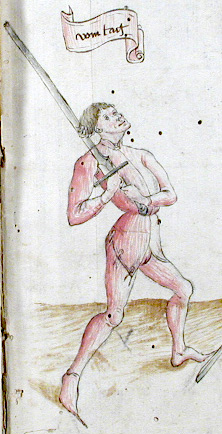
Paulus Kal - 1507
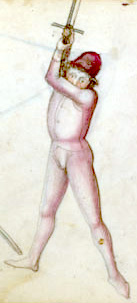
Glasgow Fechtbuch 1508
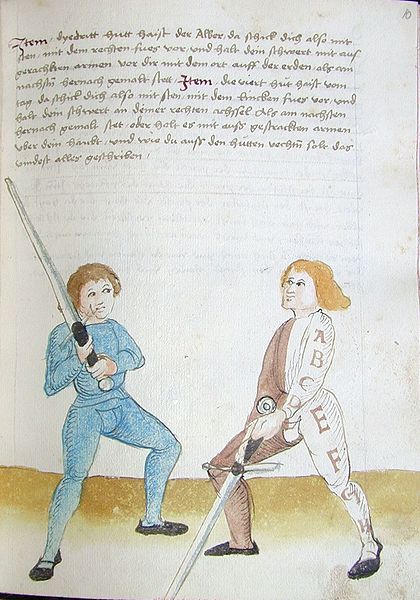
Andreas Paurnfeindt - 1516
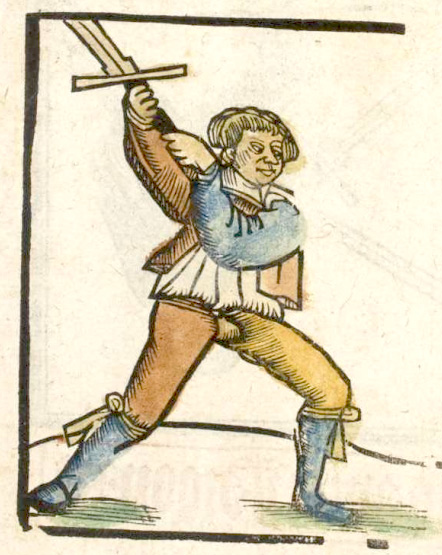
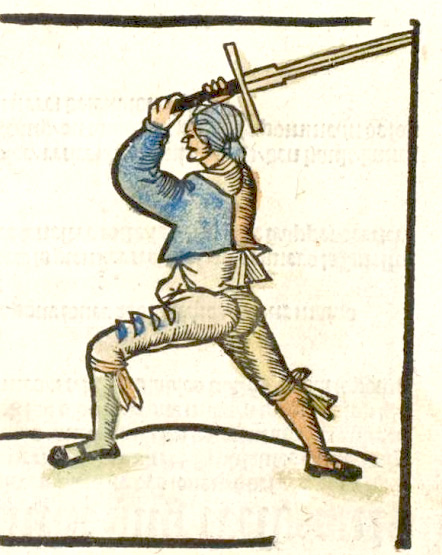
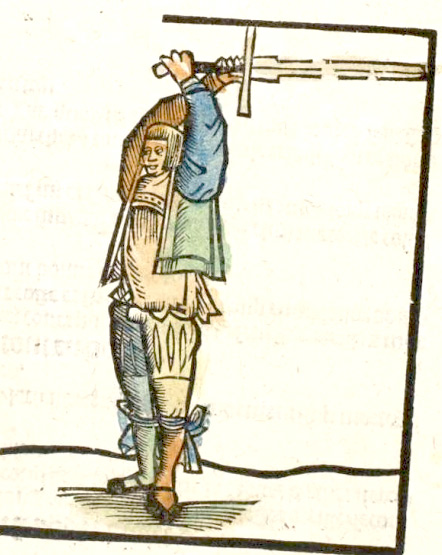
Paulus Hector Mair - 1540
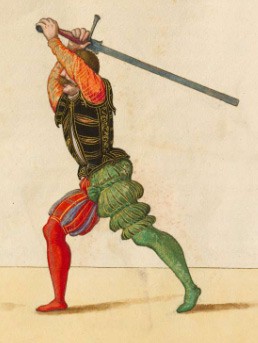
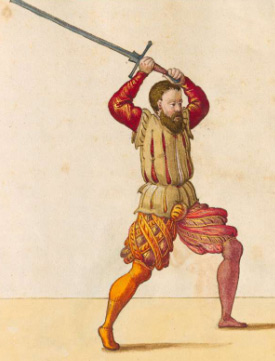
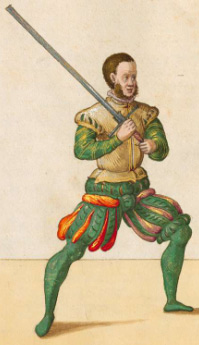
Joachim Meyer 1570